
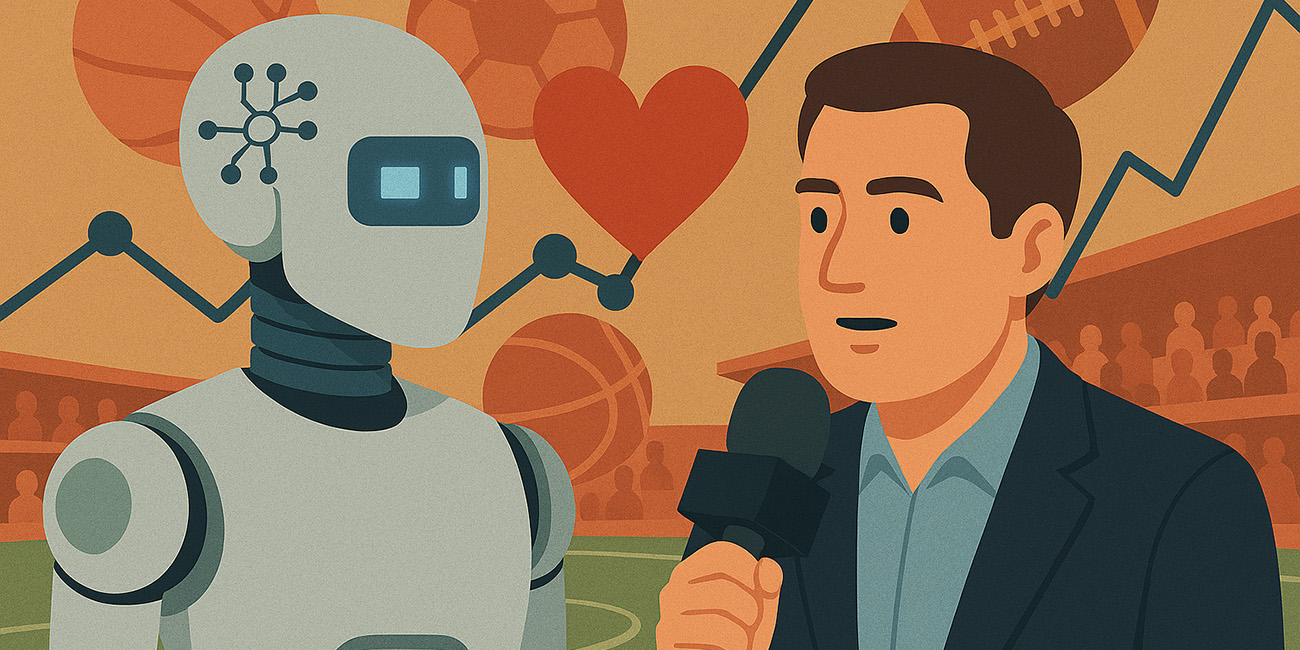
I’ve always been fascinated by the idea that the future might be predictable. Not in a mystical, crystal-ball sense, but in the mathematical, data-driven way that science has taught us to trust. This fascination recently led me to a question that millions of sports fans have probably asked in one form or another: can artificial intelligence actually predict sports outcomes?
For years, I thought the answer was a flat no. Sports are, by nature, chaotic. A single injury, an unexpected red card, or even bad weather can flip a result upside down. And unlike stock markets or scientific experiments, you can’t run the same match twice under identical conditions to see if the outcome is repeatable. But the deeper I looked, the more I realized the story isn’t so black and white.
The Illusion of Unpredictability
When we say sports are unpredictable, we often mean they’re unpredictable to the human eye. Fans rely on instinct, pundits rely on experience, and bettors often lean on a mix of statistics and gut feeling. But artificial intelligence doesn’t operate with bias or limited attention spans. It consumes vast amounts of data—player statistics, historical performance, tactical patterns, travel schedules, even subtle things like weather conditions—and searches for correlations no human analyst could realistically spot.
This doesn’t mean AI predicts with certainty. Instead, it assigns probabilities. Much like meteorologists can’t guarantee rain tomorrow but can say there’s a 70% chance, AI models evaluate matches through probabilities grounded in data patterns. And that probability-based approach is much closer to how reality actually works.
How AI Has Been Applied to Sports
Across the world, researchers and engineers have been experimenting with predictive models in sports.
- Football (Soccer): AI models evaluate past match data, player fitness, and even referee tendencies. Some teams in Europe quietly rely on predictive analytics to adjust training loads or to prepare tactical decisions.
- Basketball: The NBA has seen an explosion of advanced statistics. Machine learning is now used to predict not just team outcomes, but shot selection efficiency and injury likelihood.
- Tennis: Analysts use AI to predict matchups based on surface type, player fatigue, and head-to-head history.
The pattern is clear: AI is no longer a sci-fi fantasy when it comes to analyzing sports. It’s becoming a genuine tool, not just for teams, but for fans.
My Own Discovery: NerdyTips
I came across something interesting not long ago—a platform called sports predictions using AI. At first, I dismissed it as just another predictions site. The internet is full of places claiming to “guarantee” winning picks. But NerdyTips struck me as different, mostly because it didn’t pretend to offer certainty. Instead, it leaned on artificial intelligence as its foundation, presenting predictions as probabilities grounded in massive amounts of historical and live data.
Exploring the platform, I realized it’s not just spitting out random numbers. The site organizes predictions by leagues, provides context around each match, and continually updates as new data becomes available. It felt like peeking behind the curtain of how professional analysts think—except accelerated and sharpened by machine learning.
And here’s the key point: it doesn’t feel like hype. It feels like a real experiment in testing whether AI can consistently add value to the conversation around sports outcomes.
Why This Approach Makes Sense
Sports fans love narratives: the underdog, the star striker, the home-crowd advantage. But AI strips away the storytelling and asks only one question: what does the data say?
That doesn’t make it infallible. Upsets still happen—Leicester City’s improbable Premier League title in 2016 would likely have broken every model at the time. But probability-driven analysis does something powerful: it lets us measure how much of sports outcomes are shaped by skill, form, and context, versus pure randomness.
When NerdyTips predicts a team has a 65% chance of winning, that’s not a guarantee. But over the long run, if you track 100 such predictions, roughly 65 will hold true. That kind of consistency is where AI shows its value.
The Philosophical Question: Should Sports Be Predictable?
Part of me wonders if making sports more predictable through AI takes away some of the magic. After all, unpredictability is part of why we watch. If everyone already “knew” the outcome, would the game still thrill us?
The answer, I think, is yes—because what AI is really doing is sharpening our sense of context. It tells us why a certain team is favored, where the pressure points might be, and what factors could flip the outcome. Watching a match with that insight doesn’t ruin the suspense; it enriches it. You suddenly notice tactical nuances or player dynamics you might otherwise miss.
The Limits of AI in Sports Prediction
Despite the progress, there are clear boundaries to what AI can do.
- Human Emotion: Motivation, nerves, and mentality are incredibly hard to quantify. A player going through a personal crisis or a team rallying behind a retiring coach—these are moments where AI struggles.
- One-off Events: A red card, a controversial referee decision, or a goalkeeper having the game of their life can derail even the strongest statistical model.
- Changing Dynamics: Teams evolve. A mid-season transfer, a sudden injury crisis, or a new tactical system can throw off historical patterns.
AI learns from the past. But sports are, in many ways, about breaking patterns. That’s what makes them beautiful.
Where Does This Leave Us?

For me, discovering NerdyTips was like stumbling upon a glimpse of the future of sports engagement. Not a replacement for human intuition, but a companion to it. AI won’t—and shouldn’t—remove the drama of uncertainty. What it can do is shift the conversation from gut feelings to informed probabilities.
If anything, platforms like this prove that sports don’t need to be a battle between numbers and narratives. They can be both. You can enjoy the romantic unpredictability of a last-minute goal while also appreciating the statistical insight that told you the team had been building pressure all match.
Final Thoughts
So, can artificial intelligence predict sports? The honest answer is: partially. It can’t tell us exactly what will happen, but it can tell us with impressive accuracy what is likely to happen. And that’s more powerful than it sounds.
As someone who once thought sports outcomes were a coin toss, I’ve come to see AI as a bridge—connecting the unpredictable with the measurable. Platforms like NerdyTips are part of that bridge, giving fans a way to experience matches with a new lens.
The unpredictability of sports is never going away. But thanks to AI, we’re starting to understand it in a way that was impossible just a decade ago. And in that understanding, the games we love become even richer, more complex, and, ironically, more human.